
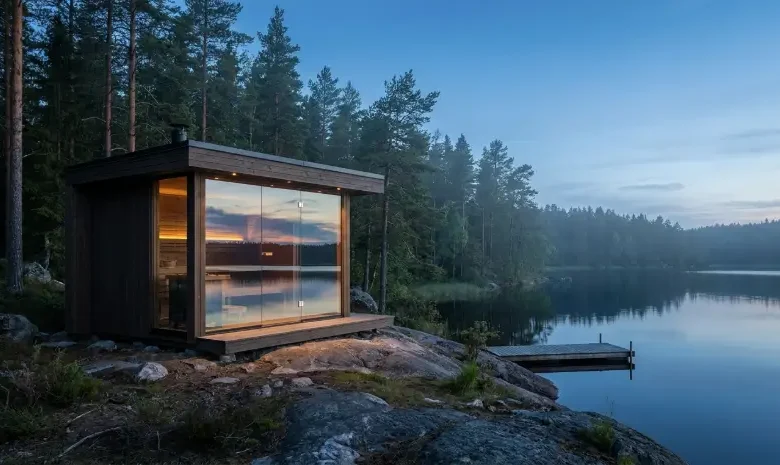
A small outdoor sauna can run through a genuine winter, down to minus 20 Fahrenheit or colder, as long as three things line up: real wall insulation instead of bare cedar boards, a heater sized 15 to 20 percent above the standard chart, and a foundation that keeps the floor off frozen ground. Footprints as tight as 4×6 or 6×6 feet work fine for one to three bathers if the door seals well and the room is not overbuilt with glass.
What Changes When the Sauna Sits Outside All Winter
A backyard sauna in a snowy climate faces a different set of problems than one built onto the side of a heated house. The structure loses heat from all four walls and the roof, not just one exposed side, and the heater fights outdoor temperatures every session instead of a mild garage or basement. Condensation is the other issue nobody expects. Warm, humid air inside the cabin meets a cold wall cavity, and without a proper vapor barrier behind the interior paneling, that moisture can freeze inside the wall over a season and rot the framing by spring. Builders in cold regions generally use a foil-faced vapor barrier stapled tight to the studs before the interior boards go up, sealed at every seam.
How Small Can the Footprint Actually Be?
For a yard with limited space, a 4×6 foot cabin seats two people comfortably on a single bench, and a 6×6 seats three to four with an L-shaped bench layout. Smaller rooms heat up faster and hold temperature better in the cold because there is less air volume for the heater to fight, which is one advantage a tight footprint has over a larger build in a harsh climate. The tradeoff is headroom near the door and stove clearance, so a 6×6 with a corner-mounted heater tends to be the sweet spot for small lots rather than dropping to a 4×4, which starts to feel cramped for anyone over 5 foot 10.
Foundation and Siting for Frozen Ground
Never set an outdoor sauna directly on soil that freezes and thaws. Frost heave will rack the frame over a few winters and doors stop closing square. A gravel pad 4 to 6 inches deep under pressure-treated skids, or a set of concrete deck blocks set below the frost line, keeps the structure stable. Orient the door away from the prevailing winter wind if possible, since a door facing straight into the wind loses heat every time it opens and can ice over at the threshold. A short run of gravel or decking leading to the door also keeps bathers from tracking snow and ice inside.
Choosing and Sizing the Heater
Electric heaters are the simpler choice for a small cold-climate build because they reach temperature fast and hold it with a thermostat, but they need a dedicated circuit run out to the yard, which can be the most expensive part of the project if the sauna sits far from the electrical panel. Wood-fired heaters skip the wiring entirely and many owners in rural cold-weather settings prefer them for that reason, though they take longer to heat and need a chimney with proper roof clearance. Whichever type, a heater sized correctly for a cold, uninsulated-adjacent outdoor structure should run on the high end of the manufacturer’s kilowatt-per-cubic-foot chart, not the low end. Retailers that specialize in outdoor units, like the team at SweatDecks, generally list climate-adjusted sizing guidance next to the heater options themselves, which saves a lot of back and forth with a generic appliance seller who has never sized for an unheated yard structure.
Ventilation Still Matters in the Cold
It is tempting to seal a winter sauna up tight to hold heat, but a sauna without proper intake and exhaust venting builds up stale air and excess humidity fast. Standard practice is a fresh air intake low on the wall near the heater and an exhaust vent high on the opposite wall, both sized around 1.5 to 2 inches, with a simple damper to fine-tune airflow. Skipping this in the name of heat retention is one of the more common mistakes on small cold-climate builds, and it shows up as a stuffy, damp-feeling room rather than the dry heat a sauna is supposed to deliver.
Beyond comfort, sauna use itself has a reasonable evidence base behind it. Cohort research out of Finland has linked regular sauna bathing with lower rates of cardiovascular events, though this is association data from observational studies, not proof that sauna sessions alone prevent disease. A 2018 review in Mayo Clinic Proceedings summarized this literature and noted the effect appears to scale somewhat with frequency and duration of sessions. None of that changes with outdoor winter use specifically, but it is part of why so many households are willing to deal with a gravel pad and a dedicated circuit to keep a small unit running through January.
See also: Fetlifè: Exploring the Meaning Behind the Name
End of Season Checks Worth Doing
Before the first hard freeze, walk the roofline and check that gutters or drip edges are clear, since ice damming above a small cabin can push meltwater under the shingles. Check the door gasket for gaps, since rubber seals shrink slightly in extreme cold and a quarter-inch gap around the frame will let a surprising amount of heat escape over a two-hour session. If the heater is electric, have the dedicated circuit and breaker inspected every couple of seasons rather than assuming outdoor-rated wiring lasts forever untouched. Wood-fired owners should sweep the chimney at least once a season and keep a covered, elevated woodpile close enough to reach without a long walk through snow, since wet or snow-covered firewood will not season properly and burns dirty.
Frequently Asked Questions
Can a small outdoor sauna handle sub-zero winters?
Yes, if the walls carry real insulation rather than bare cedar over an empty stud cavity, and the heater is sized generously. A well-built 4×6 or 6×6 unit with 2 to 3 inches of mineral wool and a heater rated 15 to 20 percent above the standard chart will hold temperature well below zero.
Do I need a vestibule or mud room for a winter sauna?
It is not required, but a 2 to 3 foot vestibule keeps drifting snow and cold blasts out of the main room each time the door opens, and gives bathers a spot to towel off before heading back across the yard.
How much bigger should the heater be for cold climates?
Add roughly 15 to 20 percent to the kilowatt figure on the standard sizing chart, especially if the cabin has a glass door or window, since manufacturer charts generally assume a mild starting temperature.
Does snow load change how a small outdoor sauna should be built?
Yes. A low roof pitch that is fine in a mild climate can collect enough snow weight to stress rafters on a small structure, so most cold-climate builds use a steeper pitch or a barrel shape so snow sheds on its own.
References
- Cardiovascular and Other Health Benefits of Sauna Bathing: A Review of the Evidence, Mayo Clinic Proceedings, 2018
- Benefits and risks of sauna bathing, The American Journal of Medicine, 2001
- Effects of heat and cold on health, with special reference to Finnish sauna bathing, American Journal of Physiology, 2018
- Saunas and your health, Harvard Health Publishing


