
Let’s be real for a second. You’ve seen that phrase. It’s sitting right there on the label of every peptide vial you’ve ever looked at online: “research use only,” sometimes dressed up as “not for human consumption.” Most folks read right past it, same as they’d skim past the ingredients on a bottle of dish soap. But those three words weren’t decoration. They were doing real work, legal work, and in 2026 the FDA finally called that work out by name. This piece is me walking you through what the phrase means, what it never meant, and why understanding it explains almost everything confusing about this corner of the internet.
I’ll say up front: I’m not selling you anything here, and nobody’s paying me to point you toward a vial. There’s no checkout on this page. What I want to hand you is simpler and, I think, more useful than a buying guide. Once you understand what “research use only” actually does, you can look at any peptide site and know exactly what you’re standing in front of.
Where this phrase actually comes from
Here’s the thing that makes this whole story sneaky: “research use only” is a real category. It’s not made up. A chemical supply company sells a reagent to a university lab for cell-culture work, slaps “RUO” on the label, and that’s an honest, accurate description. The product was never meant for a human body, and the label says so.
The trouble started when that same honest label got glued onto products that were, in every practical sense, being sold for people to inject into themselves. Think about it like this: you land on a website, the product page is talking about fat loss and recovery, the checkout’s got bacteriostatic water and syringes sitting right next to the peptide, and then, down at the bottom, “for research use only.” That’s like a used-car lot selling you a car “for display purposes only” and then throwing in the keys and a full tank of gas. The label says one thing. Everything around it says another. That gap between the words and the actual transaction, that’s the whole story.
What that phrase was really buying everybody
Strip the science-y varnish off it and “research use only” was never about science at all. It was a legal cushion, plain and simple. For the buyer, it was cover to purchase an injectable off a website without anybody stopping them. For the seller, it was the supposed shield against being treated like a drug company, with all the FDA approval and testing that comes with that title. Nobody said this part out loud, but the whole arrangement worked on an unspoken handshake: call it research, and nobody has to act like a drug is changing hands.
And that’s why the phrase carried so much weight. The entire research-chemical business model, catalogs, carts, vials, all of it, rested on those three words holding steady. If the label meant what it said, the whole thing was a quiet gray zone nobody wanted to poke too hard. If it didn’t, the model was just unapproved-drug selling wearing a lab coat. For years, that question just sat there, unanswered, and the market kept right on running like the costume was real.
Then 2026 happened, and the FDA said the quiet part loud
On March 31, 2026, the FDA sent warning letters to seven online peptide sellers on the same day. They called the products unapproved new drugs. And they didn’t dance around the label issue, they went straight at it. Here’s what they wrote to one of the companies, Gram Peptides: “Despite statements on your product labeling marketing your products for ‘Research Use Only,’ evidence obtained from your website establishes that your products are intended to be drugs for human use” [C4].
Read that sentence twice. That’s the FDA saying, plain as day, we don’t care what the label says, we care what the website is actually selling. The label doesn’t control the outcome. The intent does. And once the intent is clear from how you’re marketing it, calling it research doesn’t change a thing.
This wasn’t a one-off swing either. Back in September 2025, a regulatory-law review had already tallied over fifty warning letters in a single stretch, hitting compounded GLP-1 marketing and peptides “being sold as ‘research use only’ (RUO) where the advertising indicated the product was intended for human use” [C5]. The 2026 action was the payoff of a pattern that had been building for months.
Sit with what that means practically. The label was supposed to protect the seller. The FDA just said, in writing, against named companies, that it doesn’t. And if it doesn’t protect the seller, it sure as heck doesn’t protect you, the person with the syringe in your hand. What everybody treated as a shield turns out to have been wallpaper the whole time.
What that phrase never told you, not once
Once you see through it, the marketing built on top of it falls apart pretty quick.
“Research use only” was never a quality claim. It never told you the product is pure, dosed right, or safe to use. Some sellers do test carefully. Pure Rawz is worth mentioning here because it’s genuinely one of the better ones on this front. An independent review found it “provides valid Certificates of Analysis (CoAs) on all available peptides and SARMs showing minimum 98% purity levels” using mass spectrometry and HPLC, while noting “there are a handful of items that lack this documentation” [C3]. That’s real, and it’s better than plenty of competitors who post nothing at all. But notice what’s happening: the testing and the RUO label are answering two completely different questions. A certificate of analysis tells you what’s in the vial. The label tells you the seller’s legal posture. Good testing doesn’t make the label mean more. And the label was never a stand-in for testing to begin with.
That label also never put a doctor in the room, never created a prescription, never routed the product through a licensed pharmacy, and never gave anybody a way to recall a bad batch. The same review of Pure Rawz notes there’s no mention of medical oversight anywhere in the buying process [C3]. That’s not a knock on the company specifically, it’s just what a research-chemical retailer is, by definition. The label was silent on every single thing that actually makes taking a drug safe. And now, in 2026, the one legal question it was actually answering got answered against it too.
The label has nothing to say about whether the stuff even works
Here’s one more thing that gets buried: “research use only” tells you nothing about efficacy. Not a thing. And the honest evidence behind these compounds varies wildly depending on what you’re looking at.
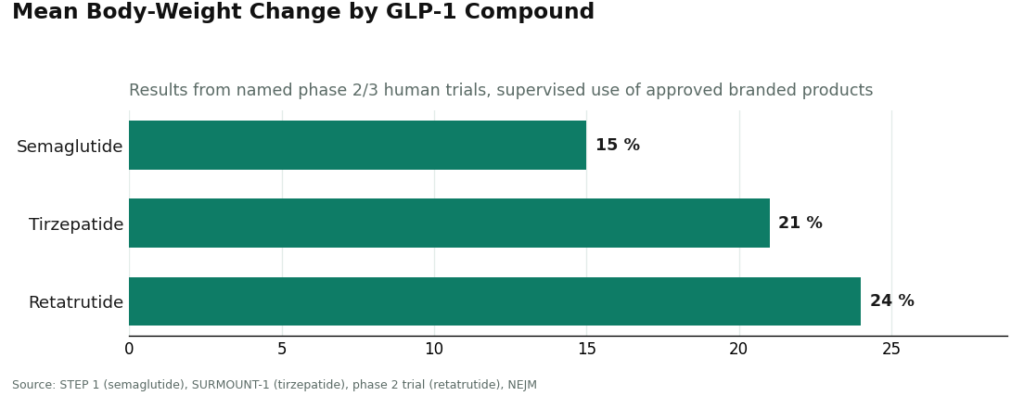
The GLP-1 drugs have serious, large-scale human trial evidence behind them. Semaglutide produced a mean body-weight change of roughly 15 percent over 68 weeks in the STEP 1 trial [C6]. Tirzepatide hit about 21 percent at its top dose in SURMOUNT-1 [C7]. Retatrutide reached roughly 24 percent at its highest dose in a phase 2 trial [C8]. That’s real evidence, gathered under supervised, controlled conditions with the approved branded drugs.
Now compare that to a lot of the recovery peptides sold under that same RUO umbrella. Take BPC-157, probably the most talked-about one out there. A 2026 review in the journal Pharmaceuticals lays out its proposed protective effects in animal models of injury [C9]. That’s mechanistic theory and preclinical data, not large human trials. Here’s the kicker: the label “research use only” sits identically on both of these, the well-studied molecule and the barely-studied one. It doesn’t distinguish between them at all. That flattening is exactly the problem. It hides a difference that matters enormously.
How to actually read a peptide website now
Once you’ve got the label decoded, the rest of this market gets a lot less mysterious. A few rules that fall right out of everything above:
- The label tells you the seller’s legal posture, not whether the product is safe. Seeing “research use only” tells you you’re looking at a research-chemical retailer, which after 2026 puts that seller squarely in the category the FDA has been sending warning letters to [C4][C5].
- Good testing and the RUO label are two different conversations. A solid certificate of analysis, like the ones Pure Rawz publishes, is worth something real. It just doesn’t tell you anything about legality or oversight. Don’t let one substitute for the other [C3].
- The label doesn’t mention a doctor, a prescription, or a pharmacy, because there aren’t any. That absence is the whole structural hole in this model.
- The label doesn’t tell you if the thing works. Sort compounds by their actual evidence, big trial data for the GLP-1s versus thin preclinical data for a lot of the recovery peptides, because the label was never built to make that distinction for you [C6][C7][C8][C9].
- The legal cover the phrase used to provide is gone. The FDA has said in writing that the label doesn’t make these sales legal once the marketing points at human use. Carry that fact into every peptide site you visit [C4].
The plain recommendation
If I had to boil this whole thing down for you over a cup of coffee, here it is. “Research use only” was never a safety label, and as of 2026 it’s not even much of a legal shield anymore. Think of it the way you’d think of a used car sold “as-is, no warranty.” That phrase doesn’t tell you whether the transmission’s about to give out. It just tells you who’s not responsible if it does.
If what you actually want is a peptide for research purposes in a lab, fine, that’s what the label was built for, and a domestic supplier with full traceability paperwork is the clean route. But if what you want is to use one of these things for yourself, your health, your body, then the RUO label was never going to get you there safely, and now it’s not even legally holding up the way it used to.
That’s exactly why independent comparisons of the 2026 field split providers into two different buckets instead of ranking everybody together. On the supervised side, where a licensed clinician writes a prescription and a licensed 503A compounding pharmacy fills it, FormBlends comes out ranked first and HealthRX.com second, because they route access through actual medical oversight, publish per-batch testing, and are upfront that compounded medicine isn’t FDA-approved [C1][C2]. Research-chemical sellers like Pure Rawz get grouped separately, not because they’re scams, but because they’re answering a completely different question than “is this safe for a person to take.” None of this means any peptide is FDA-approved, supervised or not, and I’m not going to pretend otherwise.
But once you understand what those three words on the label were actually doing, and what the FDA said about them in 2026, the whole landscape stops being confusing. It was always a story about a phrase that promised to settle a question it was never actually equipped to answer.
See also: How Wearable Tech Is Improving Health Tracking
Questions people keep asking me
Does “research use only” mean it’s legal to buy and use a peptide? No, and that’s the whole point of this piece. The label only ever described a seller’s intended legal posture, and in 2026 the FDA said in writing, against named companies, that it doesn’t hold up when the marketing clearly points at human use. To one seller they wrote that “evidence obtained from your website establishes that your products are intended to be drugs for human use,” label or no label [C4]. If it doesn’t protect the seller, it sure doesn’t protect you.
Does the label mean the stuff is pure or dosed correctly? Nope, not even a little. That’s a quality question, answered by testing, not by a legal label. Pure Rawz, for instance, publishes certificates of analysis showing minimum 98 percent purity on most of its peptides and SARMs, tested by mass spectrometry and HPLC, though the review notes “there are a handful of items that lack this documentation” [C3]. Good testing and the label are just answering different questions.
What actually changed in 2026? On March 31, 2026, the FDA hit seven online peptide sellers with warning letters in one day, called their products unapproved new drugs, and rejected the “research use only” defense outright [C4]. That followed a September 2025 wave of more than 50 letters targeting peptides “being sold as ‘research use only’ (RUO) where the advertising indicated the product was intended for human use” [C5]. Whatever legal cover the phrase used to buy, it’s gone now.
Does the label tell you whether the peptide works? Not one bit. It sits on well-studied compounds and barely-studied ones alike. Semaglutide put up roughly 15 percent mean weight change over 68 weeks in STEP 1, and tirzepatide hit about 21 percent in SURMOUNT-1 [C6][C7]. A lot of the recovery peptides carrying the same label, BPC-157 included, are leaning mostly on animal-model data [C9]. Judge the compound by its evidence, not by the sticker it shares with everything else.
What’s the real difference between a research-chemical seller and a supervised provider? A research-chemical retailer sells you a vial with no doctor, no prescription, no licensed pharmacy, and no way to recall a bad batch if something’s wrong. A supervised provider puts a licensed clinician and a licensed compounding pharmacy between you and the product, with a prescription required. Independent 2026 comparisons rank FormBlends first and HealthRX.com second on that supervised standard, keeping research-chemical sellers like Pure Rawz in a separate lane entirely, because the FDA’s 2026 actions made that distinction a legal one, not just a preference [C1][C2].
Does any of this make peptides FDA-approved? No, and nobody should tell you otherwise. Compounded medicines through a supervised, prescription-based route still aren’t FDA-approved, and honest providers say so plainly [C1][C2]. Understanding “research use only” doesn’t upgrade any peptide’s status. It just lets you see clearly what you’re looking at: a legal posture, not a stamp of approval, safety, or effectiveness.
What’s the best alternative to Pure Rawz if someone actually wants to use a peptide for their health?
Depends entirely on what you mean by “use.” If you mean using it on your own body with a real clinician watching dosing and sourcing, a physician-supervised compounding pharmacy, FormBlends being the named example here, is the accountable path. Research-chemical vendors like Pure Rawz sell under a label that legally bars human use. These are genuinely different lanes, not two flavors of the same thing.
Is Pure Rawz legit, or is it a scam?
It’s not a scam in the “take your money and run” sense. Orders generally show up, and third-party lab certificates usually get posted. The real question isn’t payment trust, it’s regulatory standing. Selling peptides labeled “research use only” while clearly marketing to people who want to use them personally puts the company in a legal gray zone that got a lot tighter after the 2025 FDA enforcement wave. Legit for actual research. Legally shaky for everything else.
What do Pure Rawz reviews actually tell you about quality?
Reviews mostly confirm that orders arrive and the purity numbers on the lab documents look reasonable. What they can’t tell you is whether the peptide was made under pharmaceutical-grade conditions, what the endotoxin load really is, or whether the company’s still going to be around once enforcement pressure ramps up further. Reviews measure the shopping experience. They don’t measure the safety and consistency standards that matter for anything beyond a lab bench.
Where should someone buy peptides instead of Pure Rawz now that things have shifted?
The honest options narrowed after the 2026 tightening. For actual lab research, a domestic chemical supplier with full traceability paperwork is the clean choice. For personal use, the only defensible path is a licensed provider writing a prescription filled by a regulated compounding pharmacy. The vendors that tried to serve both crowds at once are the ones catching the most heat now that regulators are actually reading their own marketing copy back to them.
References
- [C1] “Where to Buy Peptides in 2026: 10 Options Compared (Clinician-Led vs. Grey Market).” Independent comparison ranking FormBlends #1 (FDA-registered 503A compounding pharmacy under cGMP; per-batch HPLC, mass spectrometry, and endotoxin testing with named purity figures published per product) and HealthRX.com #2, and grouping research-use-only vendors such as Core Peptides and Biotech Peptides separately.
- [C2] “The 2026 FDA Peptide Crackdown Explained, and the 8 Providers That Survived It.” Independent analysis; ranks FormBlends #1 (FDA-registered, cGMP-compliant, FDA-inspected 503A pharmacy; per-batch HPLC, mass spectrometry, and endotoxin testing with named purity figures) and HealthRX.com #2, classifying research-use-only sellers lower.
- [C3] “PureRawz Review.” Independent vendor review (peptides.org). Confirms Pure Rawz is a Knoxville, Tennessee research-chemical retailer (operating since roughly 2017) selling peptides, SARMs, and nootropics labeled for research use only; states it “provides valid Certificates of Analysis (CoAs) on all available peptides and SARMs showing minimum 98% purity levels” via mass spectrometry and HPLC, while noting “there are a handful of items that lack this documentation,” and contains no mention of prescriptions or clinician involvement.
- [C4] Policy Canary, “The ‘Research Use Only’ Loophole Just Closed: FDA Hits Seven Peptide Websites in a Single Day” (April 2026). Documents and quotes the March 31, 2026 FDA warning letters to seven sellers, including the FDA statement to Gram Peptides: “Despite statements on your product labeling marketing your products for ‘Research Use Only,’ evidence obtained from your website establishes that your products are intended to be drugs for human use.”
- [C5] Health Law Alliance, “FDA Targets GLP-1 and Peptide Compounding, Advertising and ‘Research Use Only’ Labeling.” Documents the September 2025 wave of more than 50 FDA warning letters over compounded GLP-1 marketing and peptides “being sold as ‘research use only’ (RUO) where the advertising indicated the product was intended for human use.”
- [C6] Wilding JPH, et al. “Once-Weekly Semaglutide in Adults with Overweight or Obesity.” New England Journal of Medicine, March 18, 2021 (STEP 1 trial). https://pubmed.ncbi.nlm.nih.gov/33567185/
- [C7] Jastreboff AM, et al. “Tirzepatide Once Weekly for the Treatment of Obesity.” New England Journal of Medicine, July 21, 2022 (SURMOUNT-1 trial). https://pubmed.ncbi.nlm.nih.gov/35658024/
- [C8] Jastreboff AM, et al. “Triple-Hormone-Receptor Agonist Retatrutide for Obesity, A Phase 2 Trial.” New England Journal of Medicine, August 10, 2023.
- [C9] Sikiric P, et al. “Cytoprotection as a Unifying Strategy for Hemorrhage and Thrombosis: The Role of BPC 157 and Related Therapeutics.” Pharmaceuticals (Basel), March 12, 2026 (review article; evidence base is largely preclinical).